Prologue
District-Based Teacher Certifcation Model
2004
In 2004, a colleague asked me to write an article on training teachers exclusively for teaching at-risk populations. The reason is that we have trained hundreds of teachers and aides and observed their performance in the classroom.
During the days of Follow Through I spent a lot of time in at-risk schools training teachers, supervisors, and trainers. We have used close to every training format conceivable. We trained one-on-one, through apprentice-mentor models, through large group stand-up training, and through combinations of preservice, inservice, and classroom monitoring of performance. We have conducted experiments about how teachers' and supervisors' behavior changed if we changed the teacher-performance objectives of the training. We have trained aides to be teachers and have set up programs through which aides could become certified. We've trained high school students, older elementary-grade students, and peers to teach. And we have observed the results of these different combinations and formats. We know the average at-risk teacher very well. We know what her skill deficits are and how to remedy them effectively.
So when the colleague asked for a realistic training format that would create graduates that would have the experience, skill, and knowledge needed to be effective with at-risk kids, I said, "sure."
Understand that for me, a realistic training format is not one that panders to some regulations and practices (ala Common Core Standards). Rather the format recognizes that so long as we are constrained by some of these requirements, we will continue to fail.
The plan that is outlined in this paper would work, and work very well. Yes, it flies in the face of current procedures, but that's the point. The current procedures are the cause of the problem. Certified Teachers are naïve only because the institution and the state that contributed to their certification did not take any serious steps to prepare them for the job they would be expected to do. So long as regulations, policies, traditions, and laws are as they are, we're going to continue seeing unprepared people receiving licenses to teach kids who need the most sophisticated teachers.
So the plan is perfectly irreverent, and the policy-and-management critics are probably right about the main tenet of the plan, which is that teachers do not have to receive a degree to be certified to teach. Sure, it would be nice if a college or university would award degrees for people who went through a strict training program, not one that consists mostly in information that is perfectly irrelevant to doing a superior job in the classroom. But where is that college or university? Most of them are blessed by agencies that are supposed to verify that the instruction is excellent. Unfortunately, these agencies are just the other side of perfectly primitive.
This is not to say that the outline I provide for training teachers is the best way to go. Right now, I can't think of a better way, but I'm certain that if we tried to implement the blueprint, we would find more graceful ways of designing some of the structures and performing some of the functions. Anyhow, I'm not going to try to get the paper published even though I know the plan would be economically feasible, and it would have a singular advantage over all the plans that are currently viewed as serious alternatives—it would produce highly competent graduates who would not only outperform current first year teachers, but also most of the better, highly experienced teachers.
Featured Video
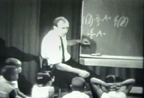
Kindergarteners Showing Off Their Math Skills 1966 Uncut demonstration of at-risk children who were taught math by Zig Engelmann as four year olds and five year olds. The session was filmed in front of a class of college students in August with no rehearsal. Children work addition, subtraction, multiplication, division problems, basic algebra problems, fraction problems, area problems, factoring, and simple simultaneous equations.