
Prologue to
Hirsch's Cargo Cults Revisited
2002
In "Classroom Research and Cargo Cults," E. D. Hirsch pleads the case for laboratory research rather than "classroom research." The Hirsch's piece is online: http://www.hoover.org/publications/policy-review/article/7262.
I don't know Hirsch's motives, but I suspect his article was simply an attempt to discredit the fact that studies involving his approach, Core Knowledge, did not show significant gains in achievement with at-risk kids. The reasons for the program's failure are obvious if one looks at the stuff he attempts to teach, which amounts to just about everything. The way he formulated his cultural-literacy scheme was to bring in loads of experts. Each had input. The sum of inputs was at best unrealistic, but nobody seemed to say, "How do we pare this mountain of information down to something that is realistic for at-risk kids?" Look at Hirsch's book, What Your Third Grader Needs to Know. Many high school kids don't know much of this stuff. .
We had firsthand experience with Core Knowledge in Baltimore, because that's the approach the Abel Foundation originally identified for their project with at-risk kids. Of course, it failed and was an insult to those who recognize sensible teaching. Teachers constructed units that stunk. The examples were not well conceived; the sequence was nonexistent; and the rate of introducing new material was far too fast.
In 1996, we started working with 13 Baltimore schools through the Abel Foundation. The foundation wanted some kind of marriage between DI and Core Knowledge. The final compromise the Abel foundation made was to use DI, as represented by the National Institute for Direct Instruction, for all the kids who were initially below grade level. In effect, that constituted all the kids we worked with, so the practices were pretty pure DI, but it still carried the label of DI and Core Knowledge, so some folks thought that Core Knowledge had something to do with the project's striking success.
Possibly the most ironic twist to the Hirsch article was that he tried to build his case on a quote from one of the really good guys in science, Richard P. Feynman, author of the book "Surely You're Joking, Mr. Feynman!"
Here's the quote:
"We really ought to look into theories that don't work, and science that isn't science. I think the educational . . . studies I mentioned are examples of what I would like to call cargo cult science. In the South Seas there is a cargo cult of people. During the war they saw airplanes with lots of good materials, and they want the same thing to happen now. So they've arranged to make things like runways, to put fires along the sides of the runways, to make a wooden hut for a man to sit in, with two wooden pieces on his head for headphones and bars of bamboo sticking out like antennas — he's the controller— and they wait for the airplanes to land. They're doing everything right. The form is perfect. It looks exactly the way it looked before. But it doesn't work. No airplanes land. So I call these things cargo cult science, because they follow all the apparent precepts and forms of scientific investigation, but they're missing something essential, because the planes don't land."
— Richard P. Feynman, "Cargo Cult Science," Surely You're Joking, Mr Feynman!: Adventures of a Curious Character (Norton, 1985).
Feynman goes on to explain that education is the premier Cargo Cult science. The irony is that if we apply Feynman's description to those who influence educational practices, Hirsch would be in that wooden hut, sitting in the first seat with the biggest sticks on his "headphone." He simply lacks educational literacy. He may be well intentioned, but he believes in magic and has no knowledge of what works or why it works.
Anyhow, the Hirsch piece was published by the Hoover Institution, conservative think tank that is part of Stanford University's charter, although many consider it an embarrassing legacy. The Hirsch article is offensive because it tries to discredit an important source of data about how miserably schools are failing — classroom research. If you can't show it in a classroom that is well implemented according to the model's standards, you can't show it.
Because the Hirsch article was published by the Hoover Institution, I figured my response should be published by the same outfit. I called to find out how I should go about submitting it. I talked to a guy named Steven Menashi, who told me I could send it to him, which I did. After several months of no response, I called again. He told me that the board was meeting shortly and I would have "The Word" soon . Nothing. So after about another month, two more phone calls, and at least one more e-mail query, I wrote him a letter in which I said: "If you don't want to publish it, tell me. I think I deserve some formal notice. Don't you? "
Mr. Menashi never responded.
At the time, I thought I would try to get the article published elsewhere (which is why I wanted the rejection notice). I since was involved in other things and never submitted the paper to any publisher. So, it's on the website. Go to article.
P.S. The Feynman book has another super chapter on education, "Judging Books by Their covers." In that chapter, Feynman agrees to review science text books. One book was completely blank.
"It turned out that the blank book had a rating by some of the other members! They couldn't believe it was blank, because they had a rating. In fact, the rating for the missing book was a little bit higher than for the two others. The fact that there was nothing in the book had nothing to do with the rating."
Featured Video
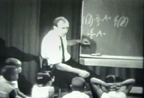
Kindergarteners Showing Off Their Math Skills 1966 Uncut demonstration of at-risk children who were taught math by Zig Engelmann as four year olds and five year olds. The session was filmed in front of a class of college students in August with no rehearsal. Children work addition, subtraction, multiplication, division problems, basic algebra problems, fraction problems, area problems, factoring, and simple simultaneous equations.