
Prologue
Impediments to Scaling Up
Effective Comprehensive School Reform Models
"Impediments to Scaling Up" is a chapter in a book that my son Kurt and I did for the RAND Corporation, Expanding the Reach of Education Reforms. The message that the chapter develops is fairly simple: the more details an approach requires, the greater the probability that a school or district will not "adopt it." Implementing a full-school, full-immersion DI model the way the National Institute for Direct Instruction does requires the school to change just about everything. The idea is to maximize all the variables that account for the acceleration of student performance. Currently, none of them are maximized in a failed school.
So if the choice for the school is between a model that requires many changes versus a model that promises acceleration of children through very few changes, schools would overwhelmingly tend to choose the model that creates less disruption. It would be something like the choice between being required to walk barefoot across hot coals and walking across warm sand. Understand that the school probably lacks technical understanding about the differences in what children and teachers learn if the school implement the NIFDI model.
The RAND Corporation originally positioned this book as one that addressed problems with up scaling. In the final version (downloadable at www.rand.org/pubs/monographs/2004/RAND_MG248.pdf), I think ours was the only chapter that was not a "case history" of the authors' models. That's unfortunate because models like America's Choice and the Edison Project attracted large numbers of schools (particularly those in districts that have ex-military personnel as "CEOs"). Unfortunately, these models achieved no substantive data of effectiveness, and they were ill conceived from the standpoint of student learning or of teaching to accelerate the cognitive growth of children.
Anyhow, I think that it's a pretty good article. Go to chapter.
Featured Video
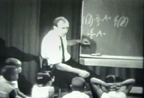
Kindergarteners Showing Off Their Math Skills 1966 Uncut demonstration of at-risk children who were taught math by Zig Engelmann as four year olds and five year olds. The session was filmed in front of a class of college students in August with no rehearsal. Children work addition, subtraction, multiplication, division problems, basic algebra problems, fraction problems, area problems, factoring, and simple simultaneous equations.